Barbell Bench Press: Form, Muscles, and Programming
Master the barbell bench press with evidence-based form cues, grip width guidance, and a programming framework that optimizes progress.
Medical Disclaimer: This content is for informational purposes only and is not a substitute for professional medical advice. Consult a qualified healthcare provider before starting any new fitness or supplement program.
In this article
The barbell bench press is the most-known exercise in any gym, but most lifters perform it suboptimally. This guide covers the form cues that separate a solid bench from a great one, how to find the correct grip width, a programming framework with concrete numbers, and the safety practices that genuinely matter.
What Is the Barbell Bench Press?
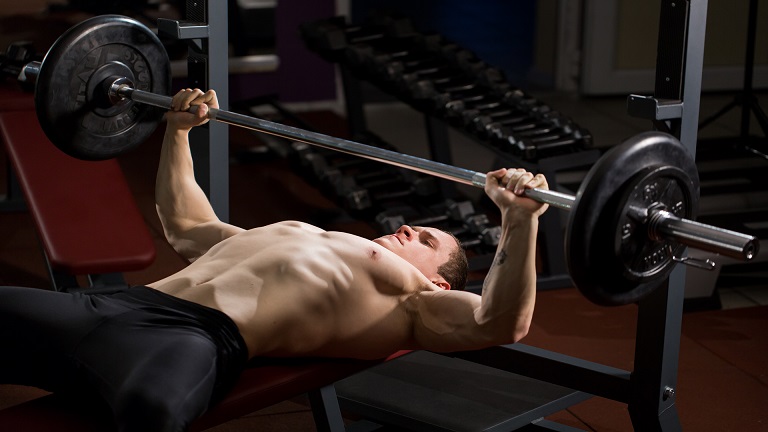
The barbell bench press is a compound horizontal pressing exercise performed lying supine on a flat bench. The lifter unracks a loaded barbell held with both hands, lowers it under control to the chest, then presses it back up to full arm extension.
It belongs to the broader pressing family along with the overhead press, incline press, and dumbbell variants. The barbell bench press is one of the three competition lifts in powerlifting (alongside the squat and deadlift) and the gold-standard test of upper body pressing strength across athletic, bodybuilding, and general fitness contexts. As a foundational upper body compound, it earns a primary spot on push day or chest day in nearly every well-designed program.
Muscles Worked by the Barbell Bench Press
The primary movers are the chest (specifically the pecs, both upper and lower portions), the front delts, and the triceps. The pecs handle the horizontal adduction, the front delts assist with the press from the bottom position, and the triceps drive the lockout at the top.
Secondary muscles include the back (the lats and traps stabilize the bar through scapular retraction), the biceps (assist with control on the descent), the core (anti-extension stabilization to maintain a tight position), and the legs (leg drive into the floor transfers force up through the body for a more stable upper back). The bench press recruits more of the body than its reputation as a “chest exercise” suggests.
How to Perform the Barbell Bench Press
Setup
Lie on a flat bench with your eyes directly under the bar. Plant your feet firmly on the floor with knees bent. Most lifters do best with feet flat, weight balanced between the heel and ball of the foot, and shins roughly vertical. Some lifters, especially competitive powerlifters, prefer feet pulled back under the body with weight on the toes and balls of the feet (heels lifted), which allows a bigger arch and more aggressive leg drive. Both setups are valid. Pick one and keep your feet anchored in that position for the entire set, whichever you choose. Some powerlifting federations require feet flat for competition; others allow feet on toes. Check the rulebook of your federation if competing.
Pull your shoulder blades together and down. Retraction alone is not enough. Active depression (pulling the shoulder blades toward your back pockets) is what creates the stable shelf the bar presses against and protects the shoulders. The cue that works for most lifters: “put your shoulder blades in your back pockets.”
Maintain a moderate arch with the rib cage lifted off the bench, but glutes still planted on the bench. This is universal best practice, not a powerlifting-only technique. The arch protects the shoulders and creates a stronger pressing position. Excessive arching is for competition, but moderate arching is for everyone.
Grip the bar with your hands about 1.5 times biacromial width (just outside shoulder-width for most lifters). Stack your wrists vertically over your elbows, with the bar sitting on the heel of the palm, not in the fingers. Wrap your thumbs around the bar. Never use a thumbless or “suicide” grip on the bench press. The bar can roll out of your hands and fall on you.
Take a deep breath into your belly and hold it. Unrack the barbell with help from a spotter if available, or by pressing it out and over your chest. At the start, the arms are perpendicular to the floor.
Going Down
Lower the bar in a slight diagonal toward the lower chest, somewhere between the lower pec line and the bottom of the sternum. The exact spot depends on arm length and grip width. The cue “bar to the bra line” works for most lifters.
Keep your elbows at roughly 45 to 75 degrees from the torso at the bottom. Closer to 75 degrees emphasizes the chest and is appropriate for hypertrophy work. Closer to 45 degrees emphasizes the triceps and is safer on the shoulders. Below 45 turns the lift into a close-grip press; above 75 puts the shoulders in a vulnerable impingement position.
Maintain shoulder blade retraction and depression throughout the descent. The chest should stay high and the upper back should stay tight. The descent should take 2 to 3 seconds, controlled, not dropped. The bar lightly touches the chest, or pauses just above it. Do not bounce the bar off the chest.
Coming Up
Drive the feet into the floor AND toward the head end of the bench. This is the actual mechanic of leg drive. Pressing straight down does nothing useful. Pressing into the floor and back toward the bench transfers force up through the glutes and into a tighter upper back position. The cue “leg press the floor away from you” works for most lifters.
Press the bar back up in the same slight diagonal it came down on, ending over the shoulders, not over the chest where it started. Squeeze the chest at the top of the rep. Finish with elbows nearly locked but not hyperextended. A small bend at lockout protects the elbow joints from hyperextension over thousands of reps.
Common Form Mistakes (and How to Fix Them)
Flaring elbows to 90 degrees: the most common cause of bench press shoulder pain and impingement. Fix: keep elbows at 45 to 75 degrees from the torso at the bottom of the rep. The cue “tuck elbows toward your hips, not toward your head” works for most lifters.
Losing shoulder blade retraction mid-set: when the shoulder blades flatten against the bench, the shoulders take over and lose their stable platform. Fix: actively pull the shoulder blades together AND down before unracking, and check that the chest stays high throughout the set. Lower the load if you cannot maintain the position.
Bouncing the bar off the chest: uses the rib cage as a spring instead of pressing through the working muscles, and risks rib injury at heavy loads. Fix: lower under control over 2 to 3 seconds, lightly touch the chest, then press. For paused work, hold the bar motionless on the chest for 1 to 2 seconds before pressing.
Bar path drift: lowering the bar to the throat or upper chest puts the shoulders in a vulnerable position. Fix: lower to the lower pec line or bottom of the sternum, not the upper chest. Cue: “bar to the bra line.”
Lifting hips off the bench: turns the bench press into a partial decline press, reduces chest involvement, and breaks competition rules if you compete. Fix: glutes stay planted on the bench at all times. If hip drive is unconscious, it’s a sign the load is too heavy.
No leg drive: wasting one of the most useful sources of stability. Fix: press your feet into the floor AND toward the head of the bench, transferring force up through the glutes and into a tighter upper back position. The cue “leg press the floor away from you” works for most lifters.
Bent-back wrists: the bar settling on the fingers instead of the heel of the palm puts the wrists in a vulnerable position and leaks force on the press. Fix: stack wrists vertically over elbows with the bar on the heel of the palm. Loaded wrists should be straight, not bent backward.
Variations Worth Knowing
Paused Bench Press
The bar is held motionless on the chest for 1 to 2 seconds before pressing. This eliminates the stretch reflex contribution and builds bottom-end strength. Required in powerlifting competition. Use during strength-focused training blocks or when you want to fix sticking points off the chest.
Touch-and-Go Bench Press
The bar lightly touches the chest and immediately presses. Allows heavier loads and more total volume than paused work. Use for hypertrophy-focused training and accessory work.
Close-Grip Bench Press
Hands inside shoulder width, more triceps emphasis. Useful for triceps strength development and as a lockout-strength accessory for bench specialists who miss reps at the top.
Wide-Grip Bench Press
Hands well outside shoulder width, more chest emphasis but increased shoulder injury risk. Use sparingly and only with confident, healthy shoulders. Per the EMG research, wide grip also reduces triceps involvement, which means total weight moved is often lower than at medium grip despite the shorter range of motion.
Incline Barbell Bench Press
Bench set at 30 to 45 degrees, more upper chest and front delt emphasis. Complementary to flat bench in a complete chest program. Most well-designed pressing routines include both flat and incline work.
Decline Bench Press
Bench set at -15 degrees, more lower chest emphasis but increased shoulder risk and reduced range of motion. Less commonly programmed than flat or incline. Worth experimenting with for lifters specifically training lower chest emphasis.
Dumbbell Bench Press
Allows greater range of motion at the bottom and unilateral imbalance correction at the cost of absolute load. Use as accessory work or as a substitute when shoulders need a break from heavy barbell pressing.
Floor Press
Bench press performed lying on the floor, with elbows pausing on the floor at the bottom. Reduced range of motion targets lockout strength and can be safer for shoulders prone to impingement. Useful when training at home without a proper bench.
How to Program Barbell Bench Press
The bench press fits naturally on push day, upper body day, or as the main pressing lift in a 4-day split. It pairs cleanly with horizontal pulling work on the same day, with the barbell bent over row being the classic pairing for a balanced push-pull session.
For pure strength work, 3 to 5 sets of 3 to 5 reps at 80%+ of 1RM. For hypertrophy, 3 to 4 sets of 6 to 12 reps at 65 to 75% of 1RM. The fuller breakdown on rep ranges for muscle growth applies here.
For most people bench pressing 1-2 times a week is plenty. Higher frequency can benefit those who prioritize strength gains and want to practice the skill aspect of the lift more often. Using this approach requires being sensible on volume. You can’t destroy your chest and expect to train it again 48h days later.
Working Weight Benchmarks
Beginner: 0.75 to 1.0 times bodyweight for 5 reps. For a 75 kg (165 lb) lifter, that’s roughly 55 to 75 kg (120 to 165 lb).
Intermediate: 1.25 to 1.5 times bodyweight for 5 reps. Same 75 kg lifter: 95 to 115 kg (210 to 250 lb).
Advanced: 1.5 to 2.0 times bodyweight or more for 5 reps. 75 kg lifter: 115 to 150 kg or more (250 to 330 lb+).
The 1.0 times bodyweight bench press for 5 reps is a meaningful intermediate strength marker. Most lifters can reach this in 12 to 24 months of consistent training. Progression on the bench press is typically slower than on the squat or deadlift because the upper body has less total muscle mass.
Progression Scheme
Once you hit the top of your rep range across all working sets, add 2.5 kg (5 lb) the following session and drop back to the bottom of the rep range. Repeat the cycle. This is double progression, and it works for beginners and most intermediates. When linear progress slows in the intermediate phase, switch to a weekly periodization scheme (heavy day plus volume day).
Should You Use a Lifting Belt for Bench Pressing?
Most lifters do NOT need a belt for bench pressing. Belts are most useful for lifts that load the spine in compression (squat, deadlift, overhead press), and the bench press loads the spine differently because the body is supine and the load runs through the chest, not the column.
Some lifters use a belt at near-maximal loads (90%+ of 1RM) for additional core bracing during the leg drive, but this is a marginal benefit. In general, train it beltless. If you’re training other lifts in the heavy ranges, see our guide on the best weightlifting belt.
Takeaway
The barbell bench press is the most direct path to upper body pressing strength and chest development you can take, and despite its reputation, the form is approachable once you understand the basics: tight upper back, planted feet, controlled bar path, elbows in the right zone. It scales to all training goals, from raw strength to hypertrophy, and rewards lifters at every level.
Frequently Asked Questions
Is the barbell bench press safe for the shoulders?
How much should I be able to bench press?
Should I bench press paused or touch-and-go?
How often should I bench press per week?
What's the difference between flat and incline bench press?
Continue reading

Dumbbell Romanian Deadlift: Form, Muscles, and Programming
Master the dumbbell Romanian deadlift with evidence-based form cues, range of motion guidance, and a programming framework for stronger hamstrings.
Barbell Hip Thrust: Form, Muscles Worked, and Programming
Master the barbell hip thrust with evidence-based form cues, foot placement, and a programming framework for stronger, more developed glutes.
Barbell Bent Over Row: Form, Muscles Worked, and Programming
Master the barbell bent over row with evidence-based form cues, muscles worked, variations, and a programming framework for strength and hypertrophy.
Free newsletter
Evidence-based fitness and health insights, delivered to your inbox.
No spam. Unsubscribe at any time.
Thanks for subscribing!