Kettlebell Goblet Squat: Form, Benefits & Variations
Master the kettlebell goblet squat with proper form, why it lets you squat deeper, and when to graduate to a barbell.
Medical Disclaimer: This content is for informational purposes only and is not a substitute for professional medical advice. Consult a qualified healthcare provider before starting any new fitness or supplement program.
In this article
The goblet squat is one of the most versatile and underrated lower-body exercises, as it can help beginners to learn proper squat mechanics and act as accessory work for intermediate and advanced lifters. Also it can be used as a mobility and injury prevention tool. Kettlebells due to their structure make a very good loading option for it.
This guide covers proper form, the biomechanics that make the goblet squat so accessible, muscle recruitment, comparisons with back and front squats, common mistakes, variations for advanced programming, and the graduation criteria for when to replace it as a main exercise.
What Is the Kettlebell Goblet Squat?
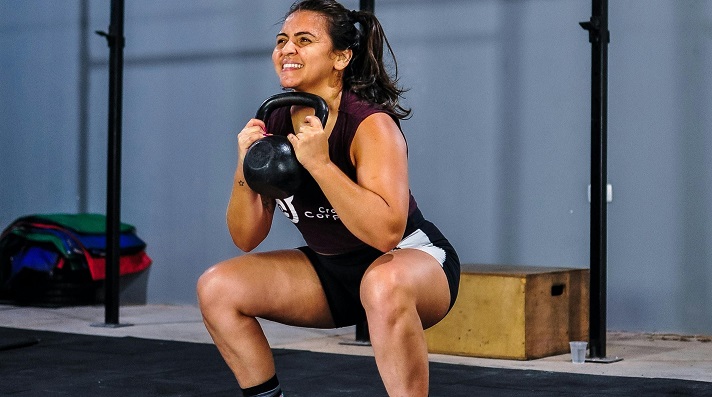
The kettlebell goblet squat is a squat pattern performed while holding a single kettlebell at chest height with both hands, like holding a goblet. The name comes from the position of your hands wrapped around the bell, similar to cradling a large cup.
Unlike a back squat (weight behind the head) or a front squat (weight in the front-rack position on the shoulders), the goblet squat places the load directly in front of the chest. This front-loaded position changes the mechanics of the squat in useful ways. It forces an upright torso, reduces lumbar shear compared to back squats, and lets the weight act as a counterbalance that helps you sit deeper.
The goblet squat was popularized by strength coach Dan John in the early 2000s as a teaching tool and has since earned a permanent spot in programs ranging from general fitness to athlete strength and conditioning.
Muscles Worked by the Kettlebell Goblet Squat
It recruits most of the major muscle groups in the lower body and engages the core and upper back for stabilization.
Primary Movers
The quadriceps are the primary movers throughout the squat, responsible for extending the knee on the way up. The front-loaded position tends to bias quad activation slightly more than a back squat, because the torso stays more upright and the knee travels further forward over the toes.
The gluteus maximus is heavily involved, particularly at the bottom of the squat and during the initial drive out of the hole. Depth matters here. Deeper squat positions recruit significantly more glute than partial or parallel positions.
The hamstrings contribute to hip extension as you drive up from the bottom and help stabilize the knee joint. Their involvement is less than the quads and glutes but still meaningful, especially in deeper squats where hip flexion angle is greatest.
The adductors (inner thigh) also act as a hip extensor at the bottom of the squat. Their contribution is often underrated, but at the deepest portion of the squat it’s doing real work helping drive the hips out of the hole.
Supporting Muscles
The core (rectus abdominis, obliques, and erector spinae) works isometrically throughout the lift to prevent the kettlebell from pulling your torso forward. This is one of the goblet squat’s underrated benefits. It’s essentially a loaded anti-flexion core exercise built into a leg movement.
The upper back (rhomboids, mid and lower traps) keeps the shoulders retracted and the chest up under load. The biceps and forearms hold the kettlebell in position, which becomes a noticeable stabilization demand as loads increase.
The calves (gastrocnemius and soleus) stabilize the ankle through the full range of motion. Good ankle mobility is essential for deep goblet squats, and many lifters discover their ankle restriction during this exercise.
How to Perform the Kettlebell Goblet Squat
Proper form breaks cleanly into three phases: setup, going down, and coming up. Drilling each phase separately makes the lift feel automatic.
Setup
Stand with your feet slightly wider than shoulder-width, toes pointed out 5 to 15 degrees. Foot stance is individual. Wider stances favor more glute and adductor recruitment, narrower stances favor more quad.
Pick up the kettlebell and hold it at chest height, close to your body. Grip the horns of the kettlebell (the two sides of the handle where it meets the bell) with your palms facing each other. Elbows point straight down toward the floor, not flared outward. The bottom of the kettlebell should rest against your upper chest or sternum.
Stand tall with your chest up, shoulders pulled back and down, and core braced. Take a breath into your belly, feel the pressure around your midsection, and hold that tightness as you begin the descent.
Going Down
Break at the hips and knees simultaneously. Push your hips back slightly while bending your knees, and drive your knees outward to track over your toes. Keep your chest up and your weight balanced between the heels and the middle of the foot. The heels should never lift.
As you descend, the kettlebell acts as a counterweight. You’ll feel the front-loading pull your torso into an upright position, which is the exact mechanical benefit of this variation. Let that counterbalance work for you. Sit back and down with control.
At the bottom position, your elbows should be just inside your knees, lightly pressing outward against the inside of your thighs. This elbow-to-knee contact is your tension cue. Actively press your elbows outward into your knees at the bottom to create full-body tension and get a stronger drive out of the hole.
Aim to hit at least parallel (thighs parallel to the floor), and ideally below parallel if your mobility allows. Full depth is where the glute recruitment pays off.
Coming Up
Drive through the floor with your whole foot. Think about spreading the floor apart with your feet while pushing your hips forward and extending the knees. The chest stays up throughout. Don’t lead with your hips alone or you’ll tip forward.
As you rise, exhale smoothly at the top or hold tension through the hardest portion of the lift and exhale after the rep. For heavier sets, Valsalva breathing (breath held through the full rep, exhale at the top) gives you more core stability but shouldn’t be used on every rep of every set.
Return to the starting position with the kettlebell still pressed against your chest, reset your brace, and start the next rep.
Why the Goblet Squat Lets You Squat Deeper
This is the biomechanical angle that makes the goblet squat genuinely useful beyond beginner programming.
When you body-weight squat, your arms and torso balance in front of your hips. Most people can’t sit into a deep squat without tipping backward because they don’t have enough counterweight in front of their center of mass. That’s why beginners often fall back onto their heels or tip forward at the bottom.
Adding a kettlebell at chest height changes the equation. The weight sits in front of the body, which counterbalances your hip hinge backward. You can sit further back without falling over. Your center of mass stays balanced over mid-foot even at depths you couldn’t hit without the load.
The effect: almost every lifter can achieve greater squat depth with a 20 to 40 lb goblet than with body weight alone. This is why it’s so effective as a mobility drill, not just a strength exercise. It teaches your body what the bottom of a deep squat feels like with balanced load distribution.
A comparison study by Gullett et al. on front-loaded versus back-loaded squatting found that front-loaded squats (like the goblet squat) produced greater vastus medialis activation and significantly less trunk lean than back squats at comparable loads. That reduced trunk lean is what makes the front-loaded pattern easier on the lumbar spine, which is why goblet squats are often prescribed for lifters with lower back sensitivity.
Goblet Squat vs Back Squat vs Front Squat
All three squat variations train the same movement pattern, but they emphasize different qualities and load at different ceilings.
The goblet squat uses the smallest load (typically 30 to 90 lb maximum) but offers the best counterbalance, the most accessible depth, and the least spinal loading. It’s ideal for teaching squat mechanics, addressing mobility limitations, high-rep conditioning, and as a warm-up or accessory for heavier squat patterns.
The front squat uses the barbell in the front-rack position on the shoulders. It allows heavier loading than the goblet squat while maintaining similar upright torso benefits. The limitation is the front-rack position, which requires wrist and shoulder mobility that many lifters lack.
The back squat allows the heaviest loading (often 2x+ body weight for strong lifters) but requires more trunk lean and places more shear on the lumbar spine.
None is universally better. A complete program often cycles between them or uses them for different purposes. Goblet squats for warm-ups, mobility, and accessories. Front or back squats for heavy work.
Common Mistakes
Most form issues with the goblet squat come from a handful of recurring errors. Correcting these resolves the majority of plateaus and discomfort.
Heels Lifting Off the Ground
If your heels come off the floor at the bottom of the squat, either your ankle mobility is limited or your foot position is too narrow. Fix it by widening your stance slightly, rotating your toes further outward, or working on ankle dorsiflexion mobility outside of squat training. Never try to force depth at the cost of heel contact.
Knees Collapsing Inward
Knee valgus (knees caving toward each other) at the bottom or on the ascent indicates weak glute medius and lazy external rotation of the hips. Fix it by consciously driving your knees outward throughout the squat, both on the way down and on the way up. The cue “spread the floor with your feet” helps many lifters feel this correction.
Leaning Forward Excessively
If your chest drops forward during the descent, you’re either tipping onto your toes or letting the core lose tension. Fix it by focusing on the counterbalance role of the kettlebell. Let the weight hold your torso upright. Brace hard before descending and maintain that brace throughout the full rep.
Elbows Flaring Out
Elbows should point straight down at the bottom of the squat, not outward. Flared elbows leak upper-body tension and often cause the kettlebell to drift away from the chest. Fix it by keeping elbows tucked in tight from the start, with the kettlebell pressing against your chest or sternum.
Going Too Shallow
Stopping above parallel is the most common mistake from lifters who focus on load over depth. Since the goblet squat’s biggest advantage is accessible depth, stopping short defeats the purpose. Drop the weight and hit full range before progressing load.
Kettlebell Goblet Squat Variations
Once the standard goblet squat feels easy, variations let you target specific qualities without abandoning the pattern.
Paused Goblet Squat
Hold the bottom position for 2 to 3 seconds before driving up. The pause eliminates the stretch reflex that normally helps you out of the hole, forcing your quads and glutes to produce pure concentric force from a dead stop. Great for addressing weakness at the bottom of the lift and for building tendon stiffness.
1-1/4 Rep Goblet Squat
Descend to the bottom, come up a quarter of the way, return to the bottom, then stand fully. This doubles the time under tension at the hardest portion of the range (the first few inches out of the bottom). Especially useful for glute and quad hypertrophy.
Double Kettlebell Front Squat
Once you outgrow a single heavy kettlebell, holding two kettlebells in the front-rack position doubles your available load. This variation bridges the gap between goblet squats and barbell front squats for lifters without access to a barbell.
Bottoms-Up Goblet Squat
Hold the kettlebell with the bell pointing up (balanced on the handle) rather than cradled in the hands. This dramatically increases grip, forearm, and shoulder stabilization demands while requiring perfect bar path. Typically performed with light weight as a challenging stabilization exercise.
Goblet Cyclist Squat (Heels Elevated)
Elevate your heels on a pair of plates or a wedge while performing the goblet squat. This shifts load more aggressively toward the quads by putting the ankles into greater plantarflexion. Useful for quad hypertrophy blocks or for lifters with tight ankles who need a temporary workaround.
Programming the Kettlebell Goblet Squat
How you program the goblet squat depends on whether it’s your primary squat pattern, an accessory, or a warm-up.
For beginners using goblet squats as the main lower-body lift, 3 to 4 sets of 8 to 12 reps two to three times per week builds a solid base. Focus on depth, form, and slow controlled eccentrics before loading heavy.
For hypertrophy-focused accessory work alongside barbell squats, 3 to 4 sets of 10 to 15 reps with moderate load produces solid quad and glute stimulus without adding systemic fatigue. Paused goblet squats or 1-1/4 reps fit this role well.
For warm-ups before heavy barbell squats, 1 to 2 sets of 6 to 10 reps with a light kettlebell (20 to 35 lb) primes the movement pattern and activates the lower body. Pause at the bottom of each rep to reinforce the deep position you want under the barbell.
For conditioning and work capacity, high-rep goblet squats (15 to 30 reps per set) with light load develop muscular endurance and elevate heart rate. Common in kettlebell-based metabolic conditioning circuits.
For broader context on how squats fit into full training programs, our guide to muscle building workout plans covers weekly splits and how lower-body work fits into them.
When to Graduate Beyond the Goblet Squat
The goblet squat has a low load limit. Most lifters cap out somewhere between 70 and 90 lb, not because their legs can’t handle more, but because holding more weight at chest height becomes awkward and eventually unsafe. The kettlebell wants to pull away from your body as it gets heavier.
Replacing it as your main squat exercise depends on body weight, not absolute load. A 120 lb lifter goblet squatting 70 lb is at 58 percent of body weight, which is strong. A 200 lb lifter goblet squatting the same 70 lb is at 35 percent, still has room to load more. Using body weight ratios gives a more accurate picture of your progress.
A practical rule: when you can cleanly goblet squat 50 to 60 percent of your body weight for 10 reps, maintaining full depth and upright torso throughout, you have the strength base to progress to barbell variations. Some examples:
- 180 lb lifter: approximately 90 to 110 lb goblet squat for 10 clean reps
- 140 lb lifter: approximately 70 to 85 lb goblet squat for 10 clean reps
- 220 lb lifter: you’ll likely hit the practical kettlebell weight ceiling before the bodyweight percentage, so plan to graduate sooner regardless
The natural next step is the barbell front squat, which uses the same front-loaded mechanics but removes the load ceiling. Once front squat mechanics feel comfortable, the back squat opens up for pure strength work and progressive overload.
But this doesn’t mean abandoning goblet squats as many advanced lifters keep them in the program as warm-ups, accessory work, or for hypertrophy blocks where heavier barbell loading would be counterproductive. It remains one of the most useful lower-body exercises regardless of training level.
The goblet squat is a core compound exercise for building muscle, and understanding how to progress between squat variations is central to how to increase muscle growth over the long term.
Equipment Considerations
You need one kettlebell. That’s it. For most lifters, owning kettlebells in 25 lb, 35 lb, 45 lb, and 55 lb covers all training scenarios from warm-up to working sets. More advanced lifters might add 70 to 90 lb bells.
If you don’t have a kettlebell, a single dumbbell works almost identically for the goblet squat. Hold it vertically by one end, with both hands cupped under the top head. Mechanics are the same. For more on building a home setup around dumbbells, see our guide to strength training with dumbbells.
When you graduate to barbell squats, the rack becomes the next essential piece of equipment. Our best squat rack guide covers options from budget to premium for home gym builds. And for accessory variations like Bulgarian split squats or box squats that benefit from a bench, an adjustable weight bench opens up more programming options.
Frequently Asked Questions
Is the kettlebell goblet squat as effective as a back squat?
How heavy should my kettlebell be for goblet squats?
Can you build muscle with only goblet squats?
What's the difference between a goblet squat and a front squat?
Why does the kettlebell goblet squat hurt my wrists?
How often should I do goblet squats?
Continue reading
Barbell Bench Press: Form, Muscles, and Programming
Master the barbell bench press with evidence-based form cues, grip width guidance, and a programming framework that optimizes progress.
Dumbbell Romanian Deadlift: Form, Muscles, and Programming
Master the dumbbell Romanian deadlift with evidence-based form cues, range of motion guidance, and a programming framework for stronger hamstrings.
Barbell Hip Thrust: Form, Muscles Worked, and Programming
Master the barbell hip thrust with evidence-based form cues, foot placement, and a programming framework for stronger, more developed glutes.
Free newsletter
Evidence-based fitness and health insights, delivered to your inbox.
No spam. Unsubscribe at any time.
Thanks for subscribing!